
If you want to know How Many Clothes in 6kg Washing Machine, you are not alone. Having had experience working with both front-load and top-load machines in an Indian household, I bring in real, pragmatic tips to help prevent overloading for the best washing results.
Breaking this down in the simplest terms, choosing the washing machine means knowing how much it can handle.
What Does a 6kg Washing Machine Capacity Mean?
6kg washing machine means it is capable of taking in a dry laundry load weighing up to 6 kilograms. But it is certainly not 6kg of wet clothes or just any kind of stuff tossed in!
A 6kg machine doesn’t mean you can always put the same number of clothes inside. A few heavy jeans or towels can weigh as much as several lightweight T-shirts. The fabric, size, and thickness of the clothes all make a difference.
Most fully automatic washing machines (particularly front-load washing machines) are intended to wash an average load of daily wear for 1 to 2 people.
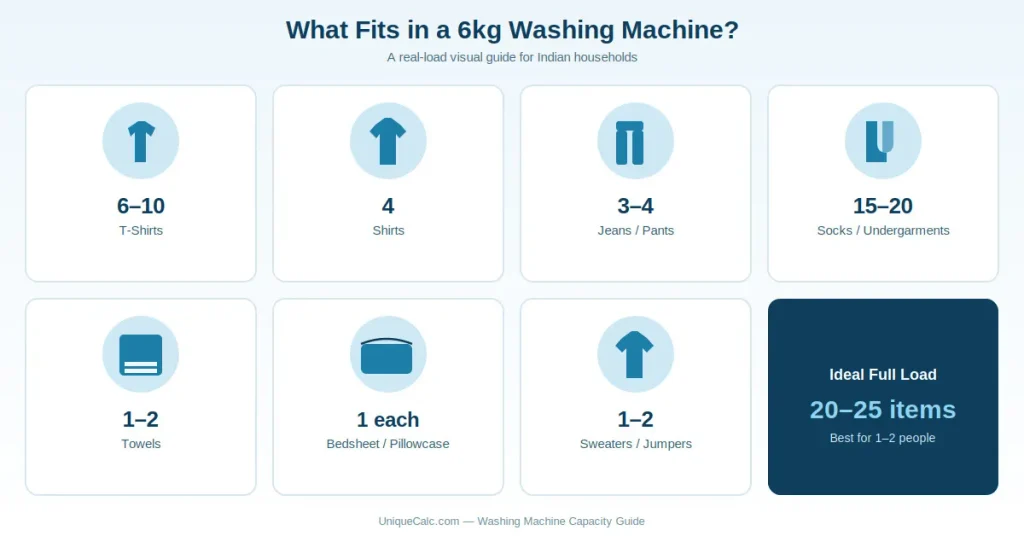
Quick Tip: Think of something between 20–25 pieces of clothing, like 10–12 T-shirts and 5–6 towels, or a blend of tops, jeans, undergarments, and one bedsheet.
Real Examples: What Fits in a 6kg Washing Machine?
Here’s a typical full load that fits well in a 6kg machine:
| Clothing Item | Quantity |
|---|---|
| T-shirts | About 6–10 |
| Shirts | 4 |
| Jeans/Pants | 3–4 pairs |
| Undergarments/Socks | 15–20 items |
| Towels | 1 large or 2 small |
| Bedsheets/Pillowcases | 1 each |
| Sweaters or Jumpers | 1–2 |
These are only rough examples, not a fixed rule. The same number of clothes can have a very different total weight depending on what you’re washing. For instance, four pairs of jeans will take up much more capacity than four lightweight shirts.
You can wash 10–12 items, such as 2 skirts, 3 pairs of pants, 1 towel, and 1 bedsheet, which is a balanced laundry load enough for efficient washing and rinsing.
Also Read: What Does IE Mean in LG Washing Machine? 5 Easy Steps for Indian Homes
Semi-Automatic vs Fully-Automatic 6kg: Which Should You Buy?
Budget tight? Semi-automatic is your answer. It’s the cheaper machine upfront, no doubt. But here’s the catch — you’re filling water manually and moving clothes to the spin tub yourself every single time. That’s real effort, not just a minor inconvenience.
Fully-automatic changes the game completely. Load it, press start, walk away. Wash, rinse, spin — done in one go. I’ve noticed front-load fully-automatic models in particular sip water compared to top-load ones (numbers below will surprise you).
So which one? If money’s the deciding factor and you don’t mind the manual work, semi-automatic gets the job done. But if your time and water bill matter more, fully-automatic front-load wins, hands down.
Front Load vs. Top Load: What’s Better for 6kg?

As with many household appliances, front load washing machines use less water and are gentle yet effective at cleaning.
Top-load washing machines are more affordable, and one does not need to bend for the loading procedure, somewhat perfect for the elderly or people with back problems.
If space permits and budget-wise isn’t an issue, go for front-load washers with a stainless steel washing tub — the latter tend to last longer and damage clothes less.
Also Read: Top 5 Washing Machine Brands in India 2025 – Specs, Price & Reviews
6kg vs 7kg — Does the Extra Kilo Matter?
Here’s the honest answer: for 1-2 people doing laundry 3-4 times a week, 6kg is plenty. You won’t feel short-changed.
But 7kg buys you breathing room. Fewer trips to the machine, and enough space to toss in a blanket occasionally without overstuffing the drum. The price jump? Usually just a few thousand rupees — not a dealbreaker.
My take: if there’s any chance your family’s growing, or you’re already borderline on load size, spend the extra now. Upgrading twice within two years costs more than the price difference ever would.
How Much Water Does a 6kg Machine Actually Use?
This one genuinely surprised me when I checked the numbers.
| Machine Type | Water Per Wash |
|---|---|
| Fully-Automatic Front Load | ~60 litres |
| Semi-Automatic | ~120 litres |
| Fully-Automatic Top Load | ~140 litres |
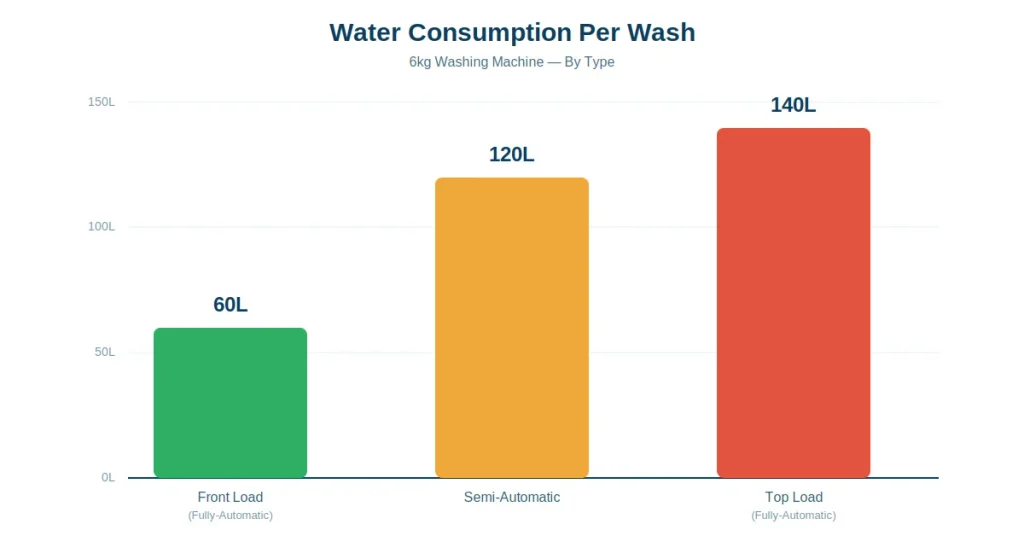
Read that again — top-load uses more than double what front-load does. For the same load. In cities already stretched thin on water supply, that’s not a small difference; that’s a monthly-bill-and-conscience difference.
Electricity is a different story — don’t fall for flat “units per cycle” claims you see floating around. BEE rates washing machines by energy consumed per kg per cycle, so a 5-star machine will always beat a 3-star one, whatever the brand. Skip the generic averages — just check the star label on the machine itself before you buy.
Dos and Don’ts: Loading Your Washing Machine Right
- Do weigh your laundry roughly if unsure. An average T-shirt weighs 150–200 grams, so 6kg = around 30 T-shirts or 12 towels.
- Don’t overload. Overloading your washing machine affects cleaning, increases wear and tear, and reduces lifespan.
- Do follow the washing machine features guide provided in the manual — modern machines often come with a half-load mode too!
- Don’t pack the drum too tightly. Clothes need some room to move around during the wash. Bulky items such as towels and bedsheets can fill the drum quickly even when the total load is within the machine’s 6kg limit.
Is 6kg Enough for My Family?
- For a couple of 2 people, 6kg should typically be sufficient.
- For families of 3+, take into account 7–8kg washing machine capacities so that you can save on time and energy.
When the washing load consists mostly of large-sized items, like blankets, one should look for a machine with a larger capacity.
Also Read: Samsung Washing Machine Not Draining Water? Try This 5-Minute Fix
What Will a 6kg Washing Machine Cost You in India?
| Tier | Price Range | What You’re Getting |
|---|---|---|
| Budget (Semi-automatic) | ₹7,000 – ₹10,000 | Basic wash/spin, manual fill |
| Budget (Fully-automatic) | ₹10,000 – ₹15,000 | Standard programs, digital display |
| Mid-range | ₹15,000 – ₹25,000 | Extra wash modes, better BEE rating, quieter |
| Premium (Front load) | ₹25,000 – ₹35,000+ | Steam wash, heater, app control, steel tub |
Prices move fast — festive sales, new launches, brand offers. Treat this as a ballpark, and check live listings before you actually buy.
FAQs
How many clothes can go in a 6kg washer?
A 6kg washing machine can comfortably wash 20 to 25 items considered to be a mixture of T-shirts, shirts, jeans, undergarments, and a towel, without overloading the drum.
How many bedsheets in a 6kg washing machine?
In a 6kg capacity washing machine, it is possible to wash one double bedsheet, or two single bedsheets, and some light clothes, including pillow covers or towels.
Is a 6kg washing machine enough?
Yes, a 6kg washing machine suits very well for 1 to 2 people or couples with some laundry, but families with kids need a larger capacity of 7–8kg to be more efficient.
How many T-shirts are in 1 kg?
Generally, 4 to 6 lightweight cotton T-shirts will comprise 1kg, depending on the thickness of the fabric and size.
How many kg of washing machine for family of 4?
Washers of 7-8 kilograms are recommended by washing machine experts for the so-called family of four, enabling people to wash a full load of daily clothes, towels, and bedsheets in a single go.
Does 6kg mean 6kg of dry clothes?
Yes. The washing machine’s capacity refers to the approximate weight of the dry laundry. It doesn’t mean the machine can hold a fixed number of clothes. Jeans, towels, sweaters, and bedsheets can weigh or take up much more space than lightweight everyday clothes.
Also Read: Spin Not Working In Washing Machine? 5 Simple Fixes for Wet Clothes
Final Verdict: How Many Clothes in 6kg Washing Machine Is Just Right?
So how many clothes fill the perfect load in a 6-kg washing machine? The answer is balance. Some 20 to 25 clothes, between daily wear, towels, and bedsheets, would be just right.
It’s a fine option for couples, working professionals, or small families, ensuring efficient cleaning without wasting water or power. Remember that overloading compromises wash quality and shortens machine life; therefore, load the machine wisely for optimum results.
